
Hummel Note
Research notes of composer Hummel

The most detailed Japanese website about the composer
J. N. Hummel. Includes his life, works, and audio listening.
2. Deep friendship with Beethoven: The controversy surrounding the dedication of "Für Elise"

I previously discussed this topic in a blog post titled " Is 'Für Elise' actually 'Für Elisabeth'? ". Since the link within that blog post was broken, I've included a link to the original article below.
Social Circles in Vienna and Beethoven’s “Rhenish Temperament”
Among the many aspects of Elisabeth Röckel’s life, the one that has most persistently fascinated later music historians is her exceptionally close and deeply personal relationship with the great composer Ludwig van Beethoven. Her brother Joseph, through his involvement in Fidelio, had developed a close friendship with Beethoven—who was said to welcome Joseph’s visits even during his busiest periods—and through this connection, Elisabeth was naturally introduced into Beethoven’s intimate inner circle.
According to multiple historical sources and testimonies from contemporaries, Beethoven is believed to have harbored very strong romantic feelings toward the young and charming Elisabeth, and there is even a theory that he seriously considered marrying her at one point. In a recollection Elisabeth herself shared around 1865 with Beethoven’s biographer Ludwig Nohl, she described an occasion when she dined together with Beethoven, Johann Nepomuk Hummel, and the renowned guitar virtuoso Mauro Giuliani (1781–1829). During this gathering, Beethoven reportedly displayed his “Rhenish temperament” to the fullest, behaving toward her with great warmth, affection, and emotional openness.
This testimony sheds light on a side of Beethoven that contrasts with the later stereotyped image of him as a difficult, solitary genius plagued by deafness. Instead, it reveals a more sociable and deeply human personality—one that modern scholarship widely acknowledges, especially given Beethoven’s well-documented romantic inclinations.
Three Candidates for the Dedicatee of Für Elise
The question of who exactly was the dedicatee of Beethoven’s Bagatelle No. 25 in A minor (WoO 59), commonly known as Für Elise, composed in 1810 and discovered and published in Munich in 1867 by Ludwig Nohl—forty years after Beethoven’s death—has long been regarded as one of the most intriguing and difficult mysteries in music history.
The original autograph manuscript has since been lost, and only Nohl’s transcription survives. As a result, the possibility of misreading Beethoven’s notoriously illegible handwriting has fueled intense scholarly debate over many years.
The table below summarizes the three principal figures who have historically been proposed as candidates for “Elise,” along with the supporting evidence and counterarguments for each.
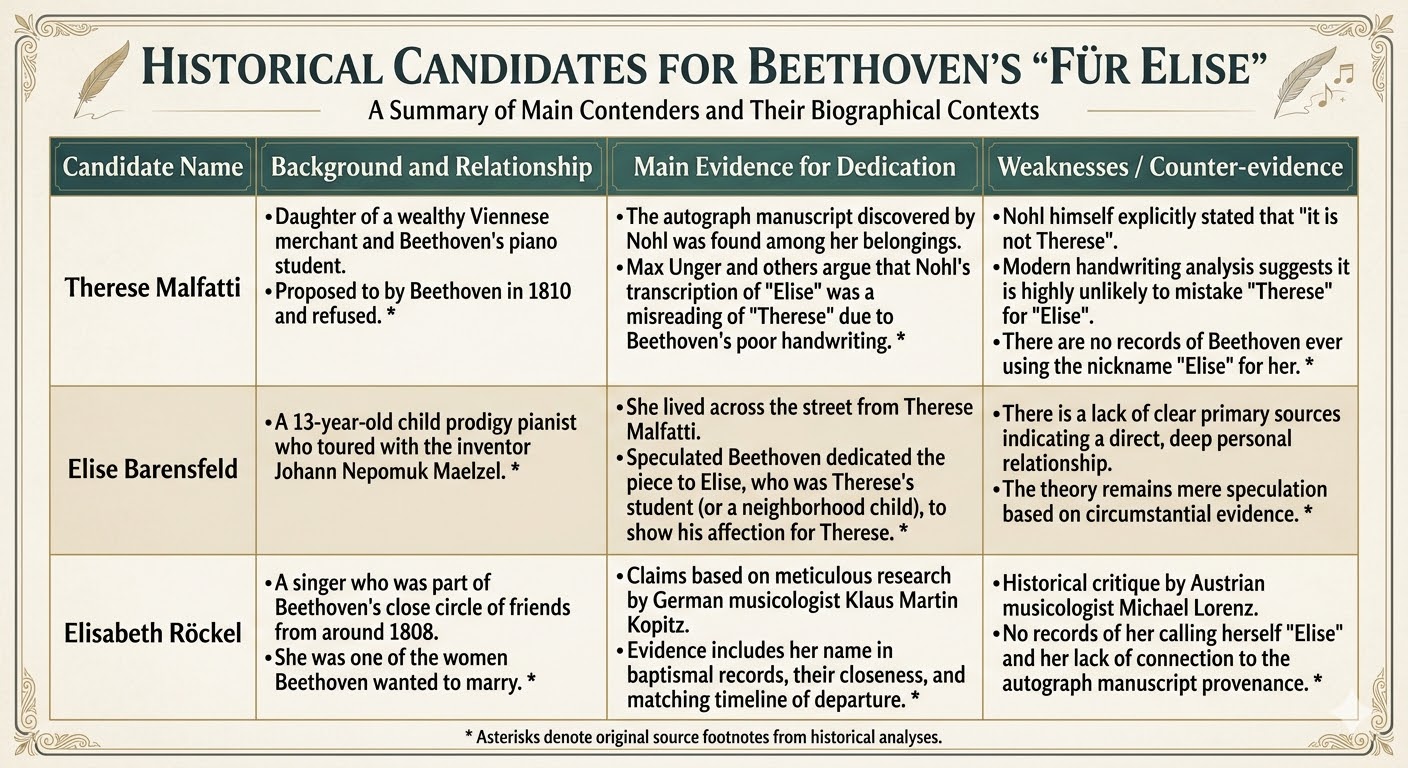
The Construction of the “Röckel = Elise” Hypothesis by Klaus Martin Kopitz
Between 2009 and 2010, the German musicologist Klaus Martin Kopitz proposed a groundbreaking hypothesis that the “Elise” in question was none other than Elisabeth Röckel. This theory generated significant attention not only within academic circles but also in the general media, including publications such as Der Spiegel.
In support of his argument, Kopitz presented four rigorous criteria along with a wide range of multifaceted evidence.※
First, there is the issue of name equivalence within the social conventions of the time. In early 19th-century Vienna, particularly during the Vormärz period, the names “Elisabeth” and “Elise” were effectively regarded as identical and were used interchangeably in everyday life. As evidence of this, in letters from her friend Anna Milder-Hauptmann, Elisabeth is clearly addressed as “Elise.” Furthermore, Kopitz identified what he considers decisive documentary proof: in the baptismal record of her first son Eduard in 1814, the mother’s name is recorded as “Maria Eva Elise.”
Second, there is the degree of intimacy reflected in the dedication. The autograph manuscript reportedly bore the inscription: “Für Elise am 27 April zur Erinnerung von L. v. Bthvn” (“For Elise on April 27, as a remembrance from L. v. Bthvn”). The act of omitting the surname and using only a first name (or nickname) would have been impossible under the social norms of the time unless the two individuals shared an अत्यremely close relationship—one in which they addressed each other by first name.
Third, there is the consistency of the timeline of personal connections. It has been established that early sketches of the piece date back to the spring of 1808. Therefore, “Elise” must already have been part of Beethoven’s circle by that time. Beethoven’s intense pursuit of Josephine von Deym had come to an end in the autumn of 1807 due to pressure from her family, and he did not meet another major candidate, Therese Malfatti, until late 1809 or early 1810. Consequently, Kopitz argues that the only woman who maintained a close relationship with Beethoven continuously from at least 1808 onward was Elisabeth Röckel.
Fourth, there is the direct motivation behind the composition and dedication. The date on which the autograph manuscript was completed—April 27, 1810—coincides precisely with the period when Elisabeth was leaving Vienna to take up a position at the theater in Bamberg. Kopitz therefore proposes that the piece was hastily finalized and presented as a “farewell memento” to Elisabeth as she departed Vienna.
In addition, from a musical-analytical perspective, he suggests that the famous principal motif of the piece was deliberately derived from the letters “E–L–I–S–E.” According to this interpretation, Beethoven encoded her name into the music by using the notes E (E), A (as a substitute for L), and S (the German note name Es, meaning D-sharp), thereby embedding her name as a musical cipher within the composition.
This hypothesis by Kopitz did more than simply identify a single woman; it was regarded, at least for a time, as a highly persuasive theory that effectively filled in a missing piece of Beethoven’s romantic timeline. As such, it was widely received as finally solving a long-standing mystery.
In response to counterarguments—such as those by Barry Cooper, who suggested that “Elise” was a coded name or pet name used to refer to Therese—Kopitz dismissed them outright. He argued that there is no evidence whatsoever that Beethoven ever called Therese “Elise,” and pointed out that in all surviving letters, Beethoven consistently addressed her as “Dear Therese.”※。
Michael Lorenz's Critique of Historical Sources and Deconstruction of Theory

Hummel's widow is pictured in a photograph taken by Ignaz Frisch in Weimar around 1860. Note the intriguing inscription: "Betty Reckel-Hummel."
However, the compelling narrative constructed by Kopitz was fundamentally dismantled in 2011 by the Austrian musicologist Michael Lorenz, a leading authority in the field. In his article “Revealing Elise” (“Die enttarnte Elise”): The Short Career of Elisabeth Röckel as Beethoven’s ‘Elise’, published in the scholarly journal Bonner Beethoven-Studien, Lorenz subjected Kopitz’s hypothesis to thorough criticism. By rigorously examining numerous primary sources that Kopitz had overlooked—such as official documents, parish records, and conscription records—Lorenz demonstrated that the hypothesis rested on what he characterized as a “misinterpretation based on fragile evidence.”
First, Lorenz addressed what had been Kopitz’s strongest piece of evidence: the 1814 baptismal record of Hummel’s son Eduard, in which the mother’s name appears as “Maria Eva Elise.” Lorenz pointed to contemporary medical and social customs, noting that women in the postpartum period were strictly forbidden from leaving their beds for nine days after childbirth. As a result, Elisabeth herself did not attend the baptism on May 9. Therefore, the entry “Elise” in the register was not based on the mother’s own declaration, but rather on inaccurate information provided by witnesses, leading to an arbitrary decision by the officiating priest.
More decisively, Lorenz discovered a later copy of the same baptismal record in which the mother’s name had already been correctly amended to “Maria Eva Elisabeth.” He emphasized that Kopitz had never consulted this corrected version.
Next, Lorenz turned to the issue of self-identification. According to his extensive documentary research, there is not a single surviving document—whether official or private—in which Elisabeth signed or referred to herself as “Elise.” Throughout her life, she consistently used the signatures “Betty” or “Maria Eva Hummel.” Even on the reverse side of a photograph taken in Weimar in 1860, she is identified as “Betty Roeckel-Hummel.”
As a matter of fact, it has been confirmed—through sources such as Viennese conscription records—that the names “Elise” or “Elisabeth” were used in everyday life not by Elisabeth herself, but rather by her mother and her younger sister, Eva Elisabeth.
Furthermore, there is a logical inconsistency concerning the provenance of the autograph manuscript. The manuscript discovered in Munich by Ludwig Nohl had been in the possession of a woman named Babette Bredl. According to Lorenz’s genealogical research, Bredl was the mother of the composer Josef Rudolf Schachner, who had inherited a number of musical manuscripts as part of the estate of Therese von Drosdick (later Therese Malfatti). In other words, the chain of transmission of the autograph can be clearly traced as: Malfatti → Schachner → Bredl → Nohl. Lorenz points out that there is absolutely no evidence whatsoever that the Hummel family ever possessed this manuscript.
Finally, there are psychological and logical inconsistencies. As will be discussed later, there are testimonies and records indicating that Elisabeth preserved, with the utmost care for over half a century until her death, items she had taken from Beethoven’s deathbed—such as a lock of his hair and his final pen—maintaining a deep sense of reverence for him throughout her life. Lorenz argues that it is logically inconceivable that a woman who cherished her bond with Beethoven to such an extent would casually part with an autograph manuscript that had been specially composed and dedicated to her, handing it over to unrelated third parties.
Applying the principle of Occam’s razor—that one should not multiply assumptions beyond necessity—Lorenz proposes a far more pragmatic explanation: Beethoven himself simply inscribed the manuscript “as a remembrance on April 27, from L. v. Bthvn,” and the phrase “Für Elise” was likely added later by Schachner, who owned the manuscript at the time, when he presented it as a gift to his wife or daughter (both of whom, coincidentally, were named Elise).
What an unexpectedly mundane and rather anticlimactic conclusion. While it lacks the malicious intentionality of Schindler’s well-known alterations, it is remarkable that later generations have been so thoroughly misled by such circumstances.
Even today, the true identity of “Elise” remains unresolved. However, this series of scholarly debates serves as an excellent case study illustrating both the difficulty of interpreting primary sources in musicology and the extent to which later Romantic-era desires can distort historical reality. At the same time, the fact that Elisabeth Röckel continues to be seriously considered by leading modern scholars as the most plausible candidate demonstrates beyond doubt how extraordinarily close she stood to Beethoven in both his emotional and intellectual world.
