
Hummel Note
Research notes of composer Hummel

The most detailed Japanese website about the composer
J. N. Hummel. Includes his life, works, and audio listening.
§5. Fantasias, Rondos, and Variations for
Piano and Orchestra
In addition to his piano concertos, Hummel composed a number of works for piano and orchestra that take the form of fantasias, rondos, and variations. These pieces, often more flexible and less formally constrained than concertos, highlight his brilliance as both a composer and virtuoso performer.
Works for Piano and Orchestra by Johann Nepomuk Hummel
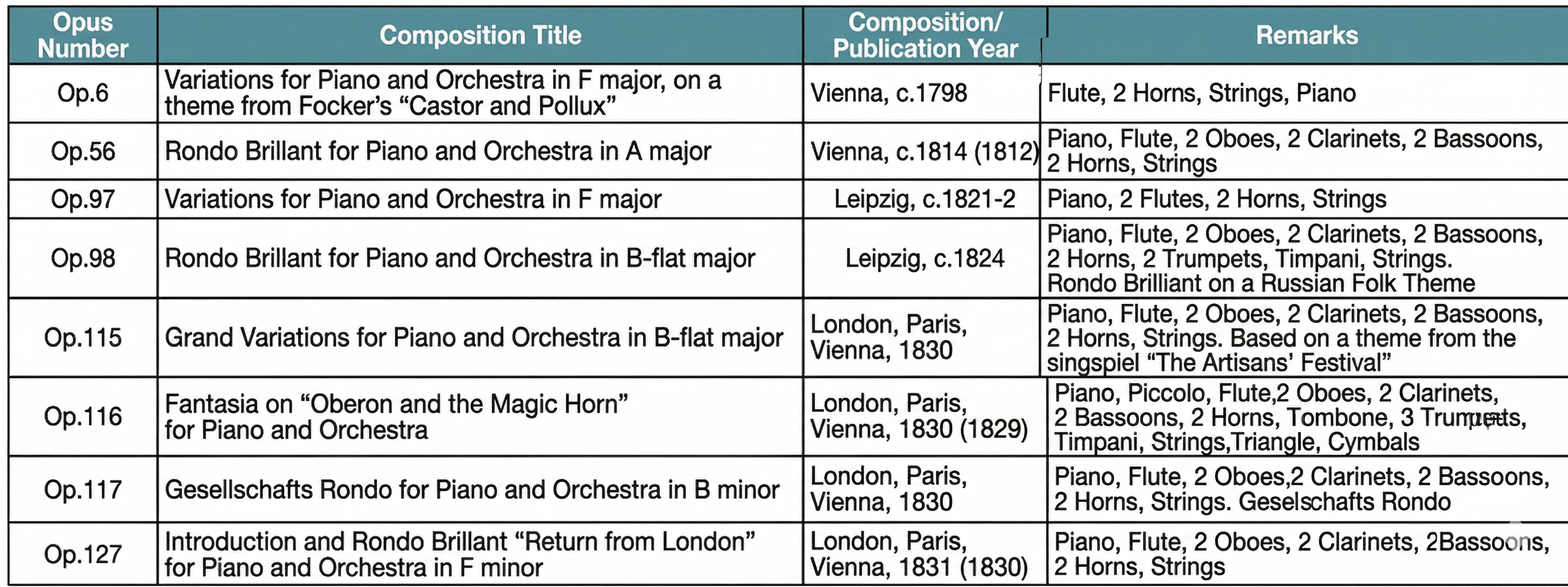
1. Variations in F Major for Piano and Orchestra, Op. 6
(on a theme from Vogler’s “Castor and Pollux”)
Date of Composition: Around 1798
Background and Context:
This work dates from Hummel’s early years, shortly after he returned to Vienna following several years of touring Europe as a child prodigy. Having lived and studied in the household of Wolfgang Amadeus Mozart during his childhood, Hummel carried forward his teacher’s stylistic influence.
At the time of this composition, he was also studying counterpoint with Antonio Salieri and Johann Georg Albrechtsberger. This piece reflects a transitional phase in his development: while firmly rooted in the Classical style inherited from Mozart, it already reveals the emergence of his brilliance as a virtuoso pianist, with increasingly elaborate and dazzling keyboard techniques.
2. Rondo Brillant (Introduction and Rondo Brillant) in A Major, Op. 56
Date of Composition: Around 1814
Background and Context:
This work coincides with the period of the Congress of Vienna, when Vienna was filled with aristocrats and diplomats from across Europe. At the time, Hummel was at the height of his fame as the leading pianist in Vienna. The piece vividly reflects the brilliant, festive atmosphere of high society, making it perfectly suited to the dazzling social and cultural life of the era.
3. Variations in F Major, Op. 97(on a Russian folk theme)
Date of Composition: Around 1821
Background and Context:
This work was likely composed, together with Op. 98, for Hummel’s concert tour in Russia. It is based on a simple Russian folk melody, treated with a bright and pastoral character. The theme’s simplicity allows for elegant and imaginative variation, culminating in a dazzling coda that showcases virtuosic brilliance and leaves a strong impression on the listener.
The orchestration is relatively modest and chamber-like, featuring pairs of flutes and horns alongside strings, which contributes to the work’s light and transparent texture.
4. Rondo Brillant in B-flat Major, Op. 98
Date of Composition: Around 1821
(Published in Vienna in 1824)
Background and Context:
Published in Vienna in 1824, this work was described by Johann Nepomuk Hummel in a letter to the publisher Peters as “one of my finest works, and not terribly difficult.” The orchestration features a full double-wind ensemble with timpani, adding brilliance and a festive, orchestral richness to the piece.
The work was composed for Hummel’s Russian tour of 1822 and dedicated to Madame Perovskaya (née Princess Gorchakov) in Saint Petersburg. During this visit, Hummel reunited with his old acquaintance John Field, with whom he had previously studied under Clementi in London. They performed together, and Hummel was notably impressed by Field’s nocturnes.
Later, in 1828, Hummel gave several concerts in Warsaw, where he met Frédéric Chopin. This rondo is believed to have been among the works performed on that occasion.
5. Grand Variations in B-flat Major for Piano and Orchestra, Op. 115
Date of Composition: 1830
Background and Context:
In 1830, Johann Nepomuk Hummel undertook a major concert tour to Paris and London, achieving great success in both cities. This set of variations was likely composed as an important part of his touring repertoire, designed to captivate and excite audiences.
The theme is drawn from the popular Singspiel Das Fest der Handwerker (“The Festival of the Craftsmen”), a widely enjoyed and accessible work that had become a hit in Berlin at the time. By choosing a familiar and cheerful melody, Hummel effectively engaged audiences while simultaneously showcasing his brilliant and highly advanced pianistic virtuosity.
This piece can thus be seen as a carefully crafted example of Hummel’s skill as an entertainer—combining popular appeal with dazzling technical display, allowing him to fully demonstrate his artistry as both composer and performer.
6. Fantasy on “Oberon’s Magic Horn” (Oberon-Fantasia), Op. 116
Date of Composition: 1829–1830
Background and Context:
This fantasy is based on the opera Oberon, which had been premiered in London in 1826 by Carl Maria von Weber to great acclaim. In the early 19th century, paraphrases and fantasies on popular operatic themes were among the most effective showpieces for virtuoso pianists, allowing them to display both imagination and technical brilliance.
In this work, Johann Nepomuk Hummel skillfully incorporates motifs such as the “magic horn” from Oberon, transforming them into a dramatic and richly expressive piece for piano and orchestra. While it draws on Weber’s material, much of the composition is Hummel’s own, giving the work a quasi-collaborative character.
The piece also reflects Hummel’s keen awareness of contemporary musical trends and his ability to captivate audiences by reimagining a widely popular opera into a virtuosic and theatrical concert work.
7. Rondo de Société in D Major, Op. 117
Date of Composition: 1829
Background and Context:
As the title “Société” suggests, this work was composed as a refined and elegant concert piece suited to aristocratic salons and fashionable musical gatherings of high society. It opens with an expressive and spacious introduction (Adagio), which leads into a brilliant and lively rondo section.
Rather than emphasizing dramatic confrontation between soloist and orchestra, the piece highlights a harmonious and intimate dialogue between them, creating a sense of graceful ensemble playing. This reflects the atmosphere of contemporary social life, capturing the elegance and charm of elite gatherings.
The work stands as a fine example of Johann Nepomuk Hummel’s late style—marked by sophistication, balance, and a gentle, cultivated beauty.
8. Rondo Brillant “Le retour de Londres” (Return from London) in F Major, Op. 127
Date of Composition: 1830
(Published in Vienna in 1835)
Background and Context:
This work, titled Le retour de Londres (“Return from London”), was published in Vienna in 1835. Interestingly, in a letter from the same year, Johann Nepomuk Hummel referred to it as “Return to Lourdes,” suggesting some ambiguity or variation in its naming.
The piece begins with a characteristically beautiful and expressive slow introduction, followed by a rondo theme with a march-like character. Throughout its episodes, richly expressive lyricism alternates with brilliant virtuosity. Structurally, it represents a highly refined and complete example of the rondo form, demonstrating that Hummel’s creative vitality remained strong even in his later years.
Notably, the autograph manuscript preserved in the British Library contains numerous corrections and notational omissions, suggesting that the work may have been completed in some haste.
§7. Hummel’s Piano Concertos as a Blind Spot
in Music History
The piano concertos of Johann Nepomuk Hummel represent an extraordinarily unique and valuable body of work, encapsulating a pivotal historical moment when music was transitioning from an “elegant craft” cultivated in aristocratic courts to an “artistic spectacle” capable of thrilling the emerging bourgeois audiences in large concert halls.
His music does not, like that of Ludwig van Beethoven, lay bare inner turmoil or engage in a struggle against fate and the world. For this very reason, it was unjustly undervalued in the later 19th century, when the ideal of the “romantic genius” came to dominate aesthetic thought. This neglect was compounded by the practical misfortune that his works were less compatible with the heavier mechanics of the modern piano, leading to a long period of obscurity.
However, as modern scholarship and the early music revival have made clear, Hummel’s concertos form an essential bridge between the classical balance of Wolfgang Amadeus Mozart and the brilliant Romanticism of Frédéric Chopin and Franz Liszt. They are indispensable “transitional masterpieces” in the history of music. By meticulously notating ornamentation, Hummel shifted interpretive authority away from improvisation toward the composer’s complete control of the work itself, while simultaneously exploring the technical potential of the fortepiano to its limits. His achievements can thus be seen as foundational to the development of modern piano music.
Today, when we listen to these concertos, we experience far more than mere historical documents. We encounter the very essence of the early 19th-century Viennese sound—light, colorful, and supremely elegant. Hummel’s piano concertos remain an essential cornerstone for understanding the evolution of classical music, and through modern interpretations, they continue to shine with remarkable brilliance and freshness.