
Hummel Note
Research notes of composer Hummel

The most detailed Japanese website about the composer
J. N. Hummel. Includes his life, works, and audio listening.
§4. Complete Commentary and Analysis of
Johann Nepomuk Hummel’s Piano Concertos
Throughout his life, Johann Nepomuk Hummel composed numerous works for piano and orchestra. In addition to the officially numbered piano concertos, his output includes early works and pieces published posthumously. Taken together, his principal concertos may be outlined as follows. The following survey examines these works in chronological order and according to their opus numbers.
Piano Concertos by Johann Nepomuk Hummel
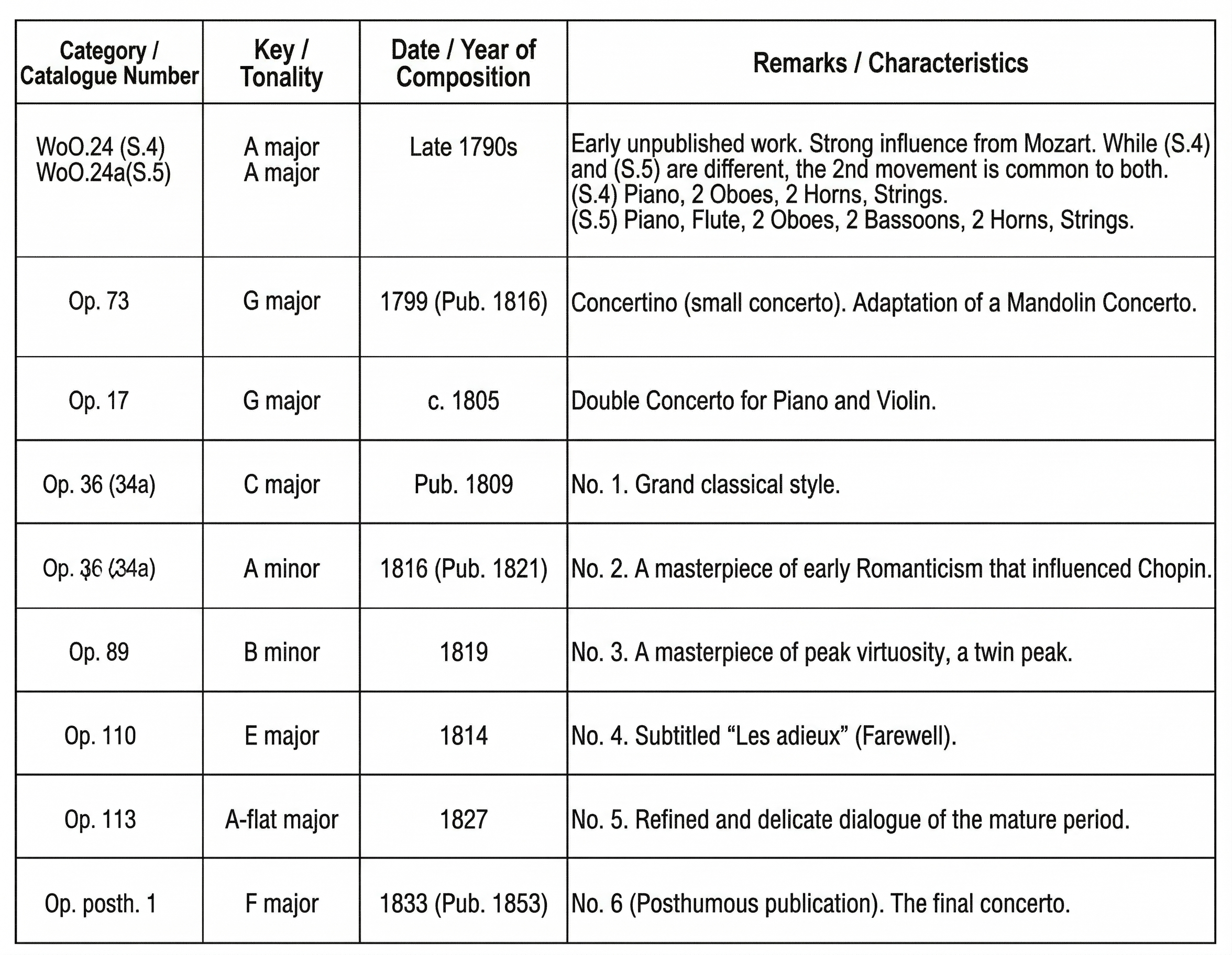
1. Piano Concerto in A Major, WoO.24 (S.4) and (S.5)
This is an early work composed in the late 1790s (around 1795–1800). It remained unpublished for a long time and was only rediscovered in the 1960s. Although both S.4 and S.5 are in A major, their instrumentation differs: S.4 is scored for piano, two oboes, two horns, and strings, while S.5 is scored for piano, flute, two oboes, two bassoons, two horns, and strings. The second movement is shared between the two versions. S.5 can be regarded as a revised version of the earlier study-like S.4, and it is the more mature and fully developed of the two.
[Musical Characteristics and Background]
This work bears a strong resemblance to the late concertos of Wolfgang Amadeus Mozart, particularly those also in A major, such as the Clarinet Concerto, K.622 and the Piano Concerto No. 23, K.488. The orchestral sound is exceptionally light and transparent. Rather than adopting a Beethoven-like approach of rigorously developing motifs, the piece emphasizes lyrical beauty through rounded, richly expressive phrases—an unmistakably Mozartian style of writing. It is a charming work that conveys, in its purest form, the spirit inherited directly from Mozart.
2. Concertino in G Major, Op. 73
Published in Vienna in 1816, this work is actually an arrangement and adaptation for piano of the earlier Mandolin Concerto in G Major (S.28), originally composed in 1799.
[Musical Characteristics and Background]
The piece is exceptionally bright, buoyant, and transparent in character, with a simple and clear structure. From the Allegro moderato of the first movement, through the Andante grazioso of the second, to the final Rondo, the work is filled with classical balance and charm. If one did not know it was composed by Hummel, it could easily be mistaken for an early, delightful piano concerto by Mozart.
3. Double Concerto in G Major for Piano and Violin, Op. 17
Composed around 1805, this work coincides—coincidentally—with the period when Beethoven premiered his groundbreaking Piano Concerto No. 4 in G Major. While there are certain stylistic similarities, the overall approach is quite different, and here too Hummel pursues classical elegance.
[Musical Characteristics and Background]
The concerto features the unusual pairing of piano and violin as solo instruments—a combination rarely explored even by Mozart. The two soloists do not simply alternate melodies; instead, they weave intricate rhythmic patterns through refined dialogue and passages in unison.
During this period, both Hummel and Beethoven were beginning to move beyond the restrained elegance of Mozart and Haydn. In this work as well, the orchestral texture becomes fuller, and the tuttis more forceful and dramatic. Nevertheless, the melodic writing and orchestration still clearly reflect the spirit of Mozart.
In the coda of the final movement, there are even traces of new sonic experimentation, such as the use of the “Janissary (Turkish band) stop”—a special feature of Viennese pianos of the time that produced percussive effects.
4. Piano Concerto No. 1 in C Major, Op. 36 (34a)
Published around 1809, this work possesses a majestic dignity and brilliance, as suggested by its key of C major.
[Musical Characteristics and Background]
Although it does not yet fully display the darker shades of early Romanticism, the concerto demonstrates a richly developed use of wind instruments and a grand-scale dialogue between piano and orchestra, embodying the structural beauty of the classical concerto tradition at its finest. Characteristic of Hummel’s style, the solo part is adorned throughout with pearly right-hand scales and trills, reflecting his confidence as a virtuoso of the time. One can also նկատ a resemblance to Mozart’s Piano Concerto No. 25 in C Major, K.503. Among Hummel’s piano concertos, this work features the most expansive and lyrical slow movement (second movement).
5. Piano Concerto No. 2 in A Minor, Op. 85
Composed in 1816 and published in Vienna in 1821, this is one of Hummel’s masterpieces—an enduring work that secured his place in music history. It stands as a historical monument that fully opened the door to Proto-Romanticism (early Romanticism).
[Musical Characteristics and Background]
The concerto employs a richly expanded orchestra for its time, including pairs of flutes, oboes, clarinets, bassoons, horns, and trumpets, along with timpani and a five-part string section. From the weighty and melancholic orchestral introduction of the first movement (Allegro moderato), the piano enters with brilliant and dramatic passages, expressing a deeply Romantic emotional intensity.
The second movement (Larghetto in F major) unfolds with long-breathed, bel canto-like lyricism. From there, a solo transition leads directly—attacca, without pause—into the final Rondo, creating a strong sense of drama and tension. The opening of the first movement may also have been inspired by Mozart’s Piano Concerto No. 20 in D minor, K.466.
This work represents a direction distinct from Beethoven’s piano concertos and had a profound influence on later composers, especially Frédéric Chopin. The fusion of melancholy lyricism and brilliant pianistic writing found in Chopin’s concertos (particularly the one in E minor) can be seen as a direct development of this Op. 85. Similarly, traces of its keyboard style appear in works such as the Concerto for Solo Piano in A minor by Charles-Valentin Alkan.
Although Robert Schumann was generally critical of much of Hummel’s output, he made a notable exception for this A minor concerto, praising its structural mastery and technical brilliance, and recognizing it as an outstanding showpiece worthy of challenge by pianists of the time.
6. Piano Concerto No. 3 in B Minor, Op. 89
Composed in 1819, this work stands alongside the A minor Concerto No. 2 (Op. 85) as one of Hummel’s two greatest masterpieces. In terms of orchestral scale and pianistic difficulty, it reaches an extreme not only within his own output but also in the broader history of concertos of the time.
[Musical Characteristics and Background]
The choice of B minor—a key imbued with deep melancholy and трагic intensity—combined with dramatic, symphonic orchestration, places this work firmly within the realm of full-fledged Romantic virtuosity. The piano writing features striking double notes, relentless leaps, and powerful octave passages reminiscent of the virtuoso études of Carl Czerny and Franz Liszt.
The first movement is dominated by overwhelming tragic tension, the second movement offers a meditative and lyrical beauty, and the final movement—a fiery Rondo—delivers breathtaking intensity. The orchestration is richly expanded, including pairs of flutes, oboes, clarinets, bassoons, and trumpets, four horns, timpani, and strings. The four horns play a particularly prominent and romantic role in the second movement. The opening of the first movement, beginning with a timpani solo, creates a striking and memorable impact.
Both the piano and orchestral parts are exceptionally developed, resulting in a concerto of remarkable substance. Historically, Franz Liszt chose this B minor concerto for his Paris debut—an indication of how this work was regarded by young virtuosos of the time as the ultimate proving ground for displaying the full extent of their technical and expressive powers.
7. Piano Concerto No. 4 in E Major, Op. 110
This work occupies a unique position among Hummel’s eight (or more, including posthumous) piano concertos, both in terms of its origins and its publication strategy. Although the opus number “110” suggests a late work, the style reflects a period more than a decade earlier—specifically the “Empire Style” associated with the years around the end of the Napoleonic Wars. This was the era of the Congress of Vienna, when Vienna was filled with monarchs and diplomats from across Europe and enveloped in an unprecedented festive atmosphere. Music functioned as an essential form of entertainment during this famously described moment when “the Congress dances, but does not progress.”
The concerto was published much later, in 1825, with the high opus number Op. 110. At that time, Hummel, serving as Kapellmeister in Weimar, undertook a long-awaited concert tour to Paris. Under the Bourbon Restoration, Paris was once again flourishing culturally, and piano manufacturing was advancing rapidly with makers such as Érard and Pleyel producing innovative instruments. Success in Paris was essential for securing Hummel’s international reputation. However, due to his busy schedule, he likely lacked the time to compose an entirely new concerto for the occasion. While he could perform already celebrated works such as Op. 85 and Op. 89, it seems he also needed the prestige of presenting a “new” work.
Thus, he adopted a strategy of “resurrecting” an earlier, unpublished piece. The E major concerto—composed in 1814, performed in Vienna but unknown to Parisian audiences and still unpublished—was likely presented as a new work.
[Musical Characteristics and Background]
Compared to the two tragic minor-key concertos (Nos. 2 and 3), this work is somewhat less well known and less frequently performed today. However, within the bright and hopeful key of E major, Hummel’s characteristic pianism is fully on display.
In revising the work, he significantly expanded its musical material and enriched the orchestration. The scoring includes pairs of flutes, oboes, clarinets, bassoons, horns, and trumpets, along with timpani and strings, with the addition of trombones—creating a more symphonic introductory section. The dialogue between soloist and orchestra is more refined, and the flowing coloratura-like passages demanded of the soloist reveal Hummel’s effort to recreate the operatic vocal style of Mozart on the piano keyboard.
8. Piano Concerto No. 5 in A-flat Major, Op. 113
Composed in 1827, this work belongs to the period of Hummel’s full maturity—at a time when Ludwig van Beethoven had just passed away and Franz Schubert was in the final year of his life. The orchestration, notably lacking oboes and instead featuring pairs of flutes, clarinets, bassoons, horns, and trumpets, lends the work an overall subdued and slightly wistful tonal color.
[Musical Characteristics and Background]
The key of A-flat major, known for its warm and rich sonority, gives the concerto a deeply sweet and serene character. Rather than showcasing the overtly brilliant and technically flashy passages of Hummel’s earlier years, this work emphasizes refined, chamber music–like interactions between the piano and the woodwinds.
That said, the technical demands remain considerable. The concerto achieves a complete fusion of orchestral color and pianistic brilliance, resulting in a large-scale work of elegance and noble refinement.
9. Piano Concerto No. 6 in F Major, Op. posth. 1
Bearing the opus number “Posthumous No. 1,” this work was composed in 1833 and published in London in 1853, after Hummel’s death. It is, in every sense, his final piano concerto. The orchestration includes a full double-wind ensemble with strings, further reinforced by trombones, adding weight and depth to the overall sound.
[Musical Characteristics and Background]
The concerto is dedicated to Grand Duchess Maria Pavlovna of Saxe-Weimar-Eisenach, Hummel’s late patron and steadfast supporter. In the first movement (Allegro moderato), after an unusually long and measured orchestral introduction, the piano enters dramatically with a cadenza, followed by a grand and imposing solo section.
The second movement (Larghetto), though relatively brief at around six and a half minutes, features an extensive and expressive solo cadenza—one of its most distinctive elements. The concerto concludes with a brilliant and energetic finale (Allegro con brio), full of virtuosity and forward momentum.
At the time of its London premiere in 1833, however, Europe was already being swept up in a new wave of Romanticism led by composers such as Frédéric Chopin, Felix Mendelssohn, and Hector Berlioz. In this changing musical climate, the concerto did not receive favorable critical reception. It stands as a poignant example of how history can outpace an artist’s aesthetic. Nevertheless, the work’s structural mastery and brilliant virtuosity remain undiminished.